
Peptide Vials and Small-Print Disclaimers: A Buyer’s Guide to Where You Actually Stand
You’ve found a site selling peptides. Clean layout, proper-looking vials, prices that seem almost sensible for something with a scientific name on it. Then, down in the small print, you hit a line that says “for research use only” and “not for human consumption.” And you stop, because that doesn’t square with the rest of the page at all.
Good. That’s the moment worth sitting with, because it tells you something the rest of the site won’t: you’re standing in front of two very different products wearing the same label. This guide is the plain version of what you’re looking at. What peptides actually are, who’s really buying them, where the evidence holds up and where it’s thin as tissue paper, and what the other option looks like if you decide you want someone with a licence standing behind what you put in your body.
No sales pitch here. Nothing in this piece links you to a checkout.
What you’re actually buying
A peptide is a short chain of amino acids, the same stuff proteins are built from. Your body makes thousands of them already. Insulin is one. The hormone that tells you you’re full after dinner is one too. So the pitch behind “research peptides” isn’t nonsense on its face: these are signalling molecules, and in theory the right one nudges a specific system, healing, appetite, sleep, in a targeted way.
For a small number of peptides, that theory has become approved medicine. For most of what’s sold online, it hasn’t. We’ll get into exactly why below, because that gap is the whole story.
Two aisles, same shop
Here’s the bit that matters most, and no product page spells it out for you.
Aisle one is the research-chemical seller. They stock the powder, label it “not for human consumption,” and sell it as a chemical, not a medicine. Biotech Peptides, one of the bigger names people search around, is upfront about this on its own site: “all products are sold for research, laboratory, or analytical purposes only, and are not for human consumption,” and the company describes itself as “a chemical supplier…not a compounding pharmacy or chemical compounding facility” [1]. Credit where due, that’s honest labelling, and it’s also the legal basis that lets them sell without being treated as a regulated drug. But walk through this aisle and there’s no one checking whether the product suits you, no prescription, no pharmacist, and nobody to ring afterwards if something’s wrong. You tick a box agreeing it’s not for humans, and the vial turns up.
Aisle two is the supervised route. A licensed clinician looks at your history and decides if a medication is right for you. If it is, they write a script. A licensed pharmacy makes it up and dispenses it. And there’s a number to call if something isn’t sitting right. The medicine might be an approved drug or a compounded version, and that distinction genuinely matters, but the structure is what counts here: a person with a licence and a duty of care is actually involved in the decision.
When people search “Biotech Peptides alternatives,” most of them aren’t after a cheaper vendor in aisle one. They’re trying to walk into aisle two.
Who’s actually buying this stuff
Strip away the “biohacker” framing and the real buyers look pretty ordinary. Someone trying to shift weight who’s heard semaglutide and tirzepatide are technically peptides, and wonders if the cheaper version does the same job. A lifter with a shoulder that won’t settle, who’s read that BPC-157 speeds up tendon healing. Someone in their forties whose sleep and energy have gone soft round the edges, curious about growth-hormone peptides. And the reader who just wants to try whatever’s newest.
Every one of them has a reasonable goal and the same problem: there’s no obvious safe place to act on it. The research-chemical sites are easy to find and easy to buy from. Easy isn’t the same as safe, and the evidence is where that gap shows up.
The evidence, and where it actually holds up
This is the bit the vial never tells you. For most of what gets sold as a “research peptide,” the human evidence ranges from thin to nearly nothing.
BPC-157 is the poster child for hype outrunning proof. A 2025 systematic review in the HSS Journal went through 36 studies on it: 35 were preclinical (animals, cells), and just one was a small clinical study of 12 patients. The reviewers found “no clinical safety data” [5]. A separate 2025 narrative review in Current Reviews in Musculoskeletal Medicine landed in the same place, noting only three pilot human studies exist, that “human data are extremely limited,” and that the compound “should be considered investigational” [6]. So when a page sells you BPC-157 next to confident healing claims, that confidence is coming from rat cages, not from people.
The weight-loss peptides sit on the other end of the shelf entirely, and it’s not luck, it’s because they went through the slow, expensive, supervised process rather than the vial-and-disclaimer route. Semaglutide and tirzepatide are themselves peptides, GLP-1 receptor agonists that work through the incretin system to slow stomach emptying, cut glucagon, and increase fullness [9]. They also have proper trial data behind them.
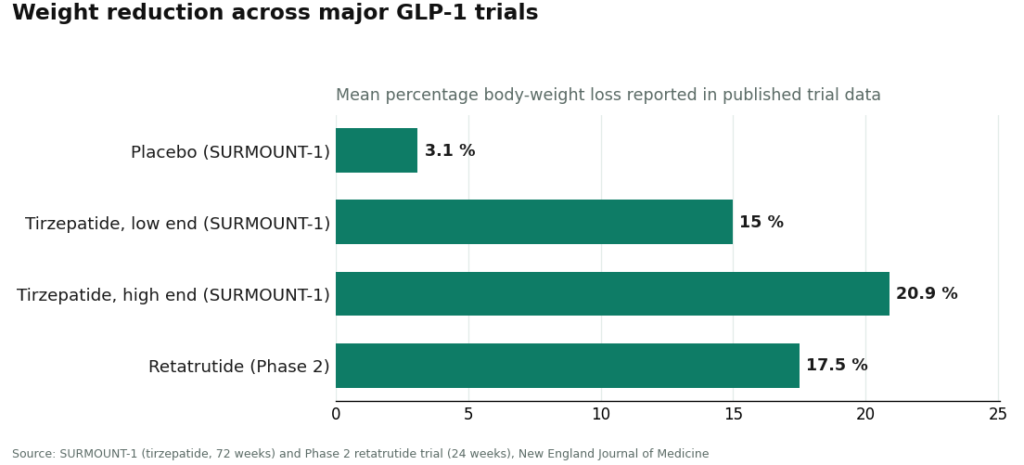
In the SURMOUNT-1 trial, tirzepatide produced mean weight reductions of 15.0% to 20.9% across doses at 72 weeks, against 3.1% on placebo [7]. Retatrutide, still investigational, showed a mean 17.5% reduction at 24 weeks in a Phase 2 trial [8]. Notice what these have in common: named trials, published data, a paper trail you can actually go read. The stuff sold as a research chemical has none of that.
So here’s the honest tally: a handful of peptides are properly studied, even approved. A much bigger group is plausible in theory and unproven in humans. That gap is the entire reason the supervised model exists at all.
What a “certificate of analysis” actually gets you
Research-chemical sellers love to wave a certificate of analysis (COA) around as proof of quality. Worth knowing what that piece of paper actually is: a document the seller chose to give you, reflecting a test on some batch, at best. It is not the same as regulatory review of identity, strength, or purity, and there’s no outside body standing behind it or able to pull a bad batch off the shelves. It’s a document, not a guarantee. Independent testing of gray-market peptide samples has repeatedly turned up products that didn’t match their own labels. That’s the exact risk a COA can’t rule out for you.
The comeback: what happens if it goes wrong
In trade terms, this is the question that matters: if the product’s faulty, who’s your comeback? Who do you actually ring?
Buy from the research-chemical aisle and the answer is nobody. You signed off on “not for human consumption.” There’s no prescriber who assessed you, no pharmacist accountable for what’s in the vial, no follow-up appointment to catch a bad reaction early.
Buy through the supervised route and the answer changes. Someone qualified made the call on whether the medication suited you in the first place, a licensed pharmacy prepared it, and there’s a channel to flag a problem. FormBlends is one example built around exactly that structure, giving access to a broad range of peptide, GLP-1, and hormone options through a clinician and a licensed pharmacy rather than a mail-order chemical vial. I’m naming it as an example of the model, not selling it to you, there’s no cart at the end of this article. FormBlends states plainly on its own site that “all compounded medications are prepared by licensed 503A compounding pharmacies following USP <797> and <800> compounding standards,” while also being clear it “is not a medical practice and does not provide medical advice, diagnosis, or treatment,” which is the honest way to describe a platform connecting people to independent prescribers.
Don’t mistake this for a free pass, though. The oversight has to actually mean something, and with GLP-1 medications it does. Semaglutide’s label carries a boxed warning for thyroid C-cell tumors and lists contraindications for anyone with a personal or family history of medullary thyroid carcinoma or MEN 2 [10]. A vial site will never ask you about your family’s thyroid history. A clinician will, because that’s the job.
The 2026 backdrop, briefly
Worth knowing because it shifted the ground this year. On March 31, 2026, the FDA sent a warning letter to research-peptide seller Gram Peptides, stating that products it offered, including retatrutide and tirzepatide, are unapproved new drugs under section 505(a) of the Federal Food, Drug, and Cosmetic Act [2]. The agency made a point of the disclaimer everyone leans on: under section 201(g)(1), a product counts as a “drug” once it’s intended to affect the body’s structure or function, and that intent gets read from the whole picture, marketing included, not just a sticker on the bottle. A near-identical letter went to Prime Sciences the same day [3]. Separately, the FDA had already warned 30 telehealth companies over illegal marketing of compounded GLP-1 products, including claims that implied equivalence to approved drugs [4]. None of these actions named Biotech Peptides specifically. The wider lesson stands regardless: “research use only” offers a buyer less cover than it looks like it does.
The bottom line
Peptides are real signalling molecules, and a small number have become genuine, well-tested medicine. Most of what’s sold online as a “research chemical” is a plausible idea with almost no human evidence behind it, sold under a label built to protect the seller, backed by paperwork the seller wrote itself. If you’re just reading up, fine, read away. If you actually intend to use one of these, the real alternative to a vial and a disclaimer is a setup where a licensed clinician, a prescription, and a proper pharmacy stand between you and the product. That’s the whole difference. Now you know which aisle you’re standing in.
Questions people actually ask
When people search “Biotech Peptides alternatives,” what are they really after? Usually not a different research-chemical seller. They want out of the gray market entirely: same kinds of molecules, but through a clinician who screens them, a prescription, and a pharmacy that actually dispenses the thing. They want the science minus the “not for human consumption” sticker doing all the legal heavy lifting.
Is a research-chemical peptide the same thing as a prescription version? The amino-acid sequence might match on paper, but “same molecule” doesn’t mean “same product.” A prescription version comes with a chain of accountability: a purity standard, a pharmacy someone can hold responsible, a clinician checking it’s right for you. A gray-market vial comes with a seller’s own paperwork and no one else in the loop, and independent testing of those samples has repeatedly found contents that didn’t match the label.
Why do semaglutide and tirzepatide have solid evidence when most peptides don’t? Because they went through the slow, supervised process instead of the vial-and-disclaimer shortcut. Both are peptides working on the incretin system, and both have large published trials backing them, including SURMOUNT-1 for tirzepatide [7]. The stuff sold as “research chemicals” skipped that process entirely, which is exactly why the human data on something like BPC-157 is so thin [5][6].
Does a certificate of analysis mean a research peptide is safe? No. It’s a document the seller chose to hand you, reflecting a test on some batch, at best. It’s not the same as regulatory review of identity, strength, and purity, and no outside body stands behind it or can recall a bad batch. It tells you a test was run once. It doesn’t tell you what’s actually in the vial in your hand.
Did the FDA name Biotech Peptides in its 2026 actions? No. The March 2026 warning letters went to other sellers, Gram Peptides and Prime Sciences, over unapproved new drugs [2][3], and a separate action targeted 30 telehealth companies marketing compounded GLP-1 products [4]. Biotech Peptides wasn’t named in any of it. The wider message still applies to the whole category: “research use only” gets read in context, marketing and all, and it protects a buyer less than the label suggests.
Is Biotech Peptides legit, or is it a scam?
It’s a research-chemical seller, not a pharmacy, so “legit” depends entirely on what you thought you were buying. Labelling products “not for human use” is a legal workaround, not a safety guarantee. Products may or may not match their labels, because there’s no mandatory third-party testing requirement in this category. Read any certificate of analysis carefully, and go in knowing you’re operating outside regulated medicine entirely.
What do the reviews of Biotech Peptides actually tell you?
They’re a mixed bag, which is exactly what you’d expect from an unregulated market. Some buyers report accurate dosing and fast shipping. Others describe inconsistent results or vials that don’t match what they ordered. Either way, no review substitutes for independent purity testing, because the reviewer almost certainly never verified what was actually in their own vial.
What’s the best alternative if I don’t want to buy from a research-chemical seller?
The most accountable route is a physician who can prescribe through a licensed compounding pharmacy. FormBlends, as one example, operates under pharmacy oversight, meaning the formulation ties back to an actual medical record, a trained prescriber, and quality standards a research-chemical vendor simply doesn’t face. It costs more and takes a consultation, but you know what’s in the vial and someone’s professionally on the hook for it.
Where should I buy instead if I want something safer?
Two honest options. First, the supervised medical route through a compounding pharmacy with a valid prescription, the only path that gets you verified pharmaceutical-grade material with a prescriber watching for side effects. Second, if you’re set on the research-chemical route regardless, look for vendors publishing recent, batch-specific third-party HPLC and mass-spec results, not one generic certificate copied across every product on the site.
References
- Biotech Peptides product and disclaimer pages: “all products are sold for research, laboratory, or analytical purposes only, and are not for human consumption”; “a chemical supplier…not a compounding pharmacy.”
- FDA warning letter to Gram Peptides, March 31, 2026. https://www.fda.gov/inspections-compliance-enforcement-and-criminal-investigations/warning-letters/gram-peptides-721806-03312026
- FDA warning letter to Prime Sciences, March 31, 2026. https://www.fda.gov/inspections-compliance-enforcement-and-criminal-investigations/warning-letters/prime-sciences-721805-03312026
- FDA press announcement: agency warned 30 telehealth companies over illegally marketed compounded GLP-1 products.
- Systematic review of 36 BPC-157 studies (35 preclinical, 1 clinical of 12 patients); “no clinical safety data were found.” HSS Journal, 2025.
- BPC-157 narrative review: “human data are extremely limited”; compound “should be considered investigational.” Current Reviews in Musculoskeletal Medicine, 2025.
- SURMOUNT-1 tirzepatide trial: mean weight reduction 15.0% to 20.9% across doses at 72 weeks versus 3.1% on placebo. New England Journal of Medicine, 2022.
- Retatrutide Phase 2 trial: mean weight reduction of 17.5% at 24 weeks. New England Journal of Medicine, 2023.
- GLP-1 receptor agonist mechanism. StatPearls, NCBI Bookshelf.
- Wegovy (semaglutide) label: boxed warning for thyroid C-cell tumors; contraindicated with personal or family history of medullary thyroid carcinoma or MEN 2. DailyMed.